
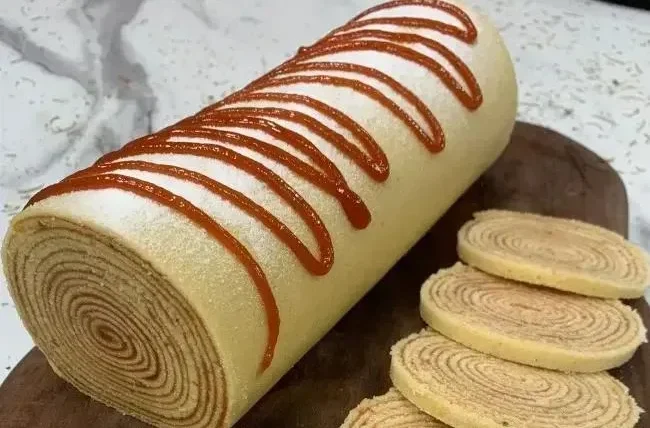
Bolo de Rolo is a traditional delicacy of Pernambuco cuisine. If you are looking for an authentic and delicious recipe to make at home, you are in the right place. In this post, we will explore the history of Bolo de Rolo (Brazilian rolled cake), the ingredients needed, the step-by-step recipe, and many tips to ensure your cake turns out perfect. Keep reading and discover everything you need to know to prepare this wonder in your own kitchen!
With a rich origin and an unmistakable flavor, Bolo de Rolo wins over palates wherever it goes. Its thin cake layers and generous guava-paste filling combine harmoniously, resulting in layers that melt in your mouth. You will also learn interesting facts and get answers to the most frequently asked questions about this delight.
History of Bolo de Rolo
The Bolo de Rolo is a delicacy whose origins are deeply rooted in Pernambuco culture and Brazilian history. Originally, it was a type of sponge cake (pão de ló), a thin and light batter rolled up with a melted guava-paste filling.
The earliest references to Bolo de Rolo date back to the 18th century, when traditional European cake recipes were adapted by Portuguese colonizers. At that time, the cake known in Portugal as bolo de rolo was actually the colchão de noiva (bride’s mattress), made with a dense almond batter. In Brazil, the recipe underwent significant changes, especially in the batter and filling, giving rise to what we know today as Bolo de Rolo.
In the colonial context, there was a fusion of culinary influences, and European recipes such as the colchão de noiva went through a tropicalization process. The abundance of tropical fruits such as guava and the need for more affordable local ingredients led to the replacement of almonds and other ingredients. Thus, guava paste became the star of the Bolo de Rolo filling.
During the 19th century, the cake began to gain popularity not only in Pernambuco but in several regions of Brazil. It was often prepared for festive occasions, weddings, and religious celebrations. Making it required specific skills, since rolling the thin batter without breaking it was (and still is) a delicate and highly technical task.
In social and cultural terms, Bolo de Rolo stood out as a symbol of sophistication and hospitality, offered as a refined and valued gift at important events. The tradition of preparing this delicacy has been passed down from generation to generation, keeping alive the art and essence of this authentic Pernambuco dessert.
Today, Bolo de Rolo is more than just a sweet treat; it is an intangible heritage of Pernambuco, officially recognized as cultural and intangible heritage of the state by the government of Pernambuco. This official recognition reflects the importance of a culinary tradition that goes beyond taste, encompassing historical, cultural, and social aspects of the region.
To preserve and promote this cultural heritage, many bakers and lovers of Pernambuco gastronomy continue to follow the traditional recipe to the letter, respecting each step of the production process. This includes the meticulous preparation of the batter, the proper cooking of the guava paste, and the refined technique of rolling thin cake layers, which give Bolo de Rolo its unmistakable appearance and texture.
In addition, the traditional recipe has been the subject of innovation and experimentation, with variations that include other fillings such as dulce de leche and chocolate, as well as adaptations of the original recipe into diet and gluten-free versions, catering to different preferences and dietary restrictions.
Specialized shops and traditional bakeries in Pernambuco are dedicated exclusively to keeping the authenticity of Bolo de Rolo alive, training new bakers and offering courses to teach the traditional techniques. In this way, the legacy of this delicacy continues to be passed on and enjoyed by future generations, preserving its cultural and historical relevance.
In short, the history of Bolo de Rolo is a rich tapestry of cultural influences, local adaptations, and culinary traditions that resulted in a distinctive dessert deeply rooted in Pernambuco and Brazilian identity. Its value and impact transcend the culinary sphere, forming an integral part of Brazil’s cultural heritage.
Necessary Ingredients
Necessary Ingredients:
To prepare a Bolo de Rolo, it is essential to gather all the ingredients in advance. The ingredient list consists of simple items that, properly combined, result in this traditional and delicious dessert.
- All-purpose flour: Use sifted all-purpose flour to ensure a light, even batter. The usual amount is about 2 cups (250 grams).
- Granulated sugar: Essential for the cake’s sweetness, you will need approximately 1 1/4 cups (250 grams).
- Eggs: Use fresh eggs, about 5 units. Separate the whites from the yolks for better incorporation into the batter.
- Butter: Unsalted butter is preferable to control the salt content. The recommended amount is 7 oz (200 grams), at room temperature.
- Guava paste (goiabada): Guava paste is the star of the filling. Use about 18 oz (500 grams) of firm guava paste, preferably goiabada cascão, cut into small pieces to make melting easier.
- Milk: One cup of milk to help with the consistency of the guava-paste filling.
- Salt: Just a pinch of salt to enhance the flavors of the other ingredients.
- Vanilla extract: A special touch to flavor the cake batter, use about one teaspoon.
- Confectioners’ sugar: For dusting over the finished cake, giving it a beautiful, appetizing look.
Having all these ingredients on hand is the first step to success in preparing Bolo de Rolo. It is also important to choose quality products, especially the guava paste, which should be tasty and firm.
To ensure your recipe is a success, carefully follow the measurements and recommendations described. Each ingredient plays a crucial role in building the flavors and textures that make Bolo de Rolo an irresistible and traditional Pernambuco dessert.
Step-by-Step Recipe
-
Prepare the Batter:
Start by beating 8.8 oz (250 g) of butter with about 1 1/4 cups (250 g) of sugar until you get a creamy, pale mixture. Add 5 egg yolks one at a time, beating well after each addition. Then gradually add about 2 cups (250 g) of sifted all-purpose flour, alternating with 1/2 cup of milk. Keep beating until the mixture is smooth.
In another bowl, beat the 5 egg whites until they form firm peaks, then gently fold them into the batter. This will give lightness to the cake batter.
-
Prepare the Filling:
For the traditional filling, use about 18 oz (500 g) of guava paste of good quality. Cut the guava paste into small pieces and cook over low heat with a little water (about 1/2 cup) until melted into a smooth paste. Stir constantly to prevent burning.
-
Bake and Assemble the Cake:
Preheat the oven to 350°F (180°C). Grease rectangles of parchment paper or sheet pans with butter and dust with flour. Pour a thin layer of batter (about 0.2 inch / 0.5 cm) onto each sheet and spread evenly.
Bake the layers for about 5-7 minutes, or until lightly golden. Remove from the oven and immediately turn out onto a clean kitchen towel dusted with sugar. Carefully peel off the parchment paper.
Spread a thin layer of filling over the still-warm cake and roll it up like a jelly roll. Repeat the process until the batter is used up, layering so that the cake builds height.
-
Finishing:
After assembling all the layers, dust confectioners’ sugar over the finished cake. Wrap with plastic wrap and refrigerate for at least 2 hours before serving. This will help the cake set and the flavors meld.
When serving, cut into thin slices and enjoy the traditional, irresistible flavor of Pernambuco Bolo de Rolo, a true delight of Brazilian cuisine.
Tips for a Perfect Cake
Choosing the Ingredients
To ensure the cake is tasty and has the right texture, choosing the ingredients is fundamental. Always use fresh, quality ingredients. All-purpose flour, eggs, sugar, butter, and guava paste are the main ones. The flour should be sifted to avoid lumps and ensure a lighter batter.
Butter Quality
Another important point is butter quality. It must be 100% butter, with no blends. Using margarine or salted butter can change the cake’s flavor and texture. Choose a good-quality unsalted butter.
Ingredient Temperature
Make sure all ingredients are at room temperature before starting the recipe. Cold ingredients can compromise the batter’s uniformity.
Beating the Ingredients
Beating the ingredients in the right order and for the right time is crucial. Start by beating the butter with the sugar until you get a pale, fluffy cream. Add the eggs one at a time, beating well after each addition.
Mixing in the Flour
When adding the flour, do so gradually and stir gently to avoid developing the flour’s gluten, which can make the batter heavy. Use a spatula or whisk and make gentle movements.
Preparing the Pan
Preparing the pan is also important. Grease it with butter and flour so the batter does not stick and unmolds easily. Some recipes suggest using parchment paper.
Spreading the Batter
Spread the batter in the pan very evenly. The batter should form a thin, uniform layer so it bakes evenly.
Oven Time and Temperature
Bake the cake in an oven preheated to 350°F (180°C). It is important to follow the baking time given in the recipe, but always keep an eye on it to prevent the batter from overbaking and drying out. Ideally, the batter should bake quickly, so it is firm to the touch but not dried out.
Cutting the Guava Paste
For the filling, the guava paste should be cut into small pieces and melted over low heat or in a double boiler. This will ensure the ideal consistency for spreading over the cake batter.
Spreading the Filling
Spread the guava-paste filling over the baked batter evenly. A thin layer is enough, ensuring each bite has just the right amount of cake and filling.
Rolling the Cake
Rolling the cake correctly is another essential step. Start from the nearest edge and use the parchment paper to help roll it up firmly. With each turn, press lightly to avoid leaving empty spaces.
Resting the Cake
After rolling the cake, let it rest a bit before removing the parchment paper. This resting time will help the cake hold its shape.
Final Touch
When unrolling, dust granulated or confectioners’ sugar on top for a finishing touch. Serve in thin slices so the rolls are clearly visible, showing off the dedicated work put into preparation.
Storage
If not eating it right away, the cake must be stored properly. Wrap in plastic wrap and keep in the refrigerator. It can be kept for a few days while retaining its flavor and texture.
Variations and Adjustments
To vary the recipe, you can replace the guava paste with other spreadable sweets, such as dulce de leche or even chocolate. However, guava paste is the traditional ingredient that gives the characteristic flavor.
Lightness and Softness
A good bolo de rolo should be light and soft. By following all these tips, from choosing the ingredients to rolling the batter, the result will be a cake with a delicate texture and unmatched flavor.
Common Mistakes
Avoid opening the oven during baking; this can cause the batter to fall. Also avoid overbeating the eggs with the butter, as this can incorporate too much air into the batter, making rolling difficult.
Practice and Patience
Finally, practice and patience are essential. Each time you make it, you will improve your technique, and the result will get closer and closer to ideal.
Fun Facts About Bolo de Rolo
The Bolo de Rolo is a traditional Pernambuco sweet that delights not only with its flavor but also with the many curiosities surrounding this delicacy. Originally inspired by the Portuguese rocambole (jelly roll), Bolo de Rolo stands out for its delicate batter and countless thin layers of guava filling.
One of the most interesting peculiarities is the art of preparing the batter. Special care is needed when spreading it so it becomes extremely thin, almost like a sponge cake. Each layer must be baked separately and then rolled with the filling, forming several turns that give the sweet its main characteristic. This process, which may seem complicated, is what guarantees the light, soft texture of Bolo de Rolo.
Another curiosity is the historic listing of Bolo de Rolo as intangible heritage of Pernambuco, granted by Iphan (Institute of National Historical and Artistic Heritage) in 2008. This title recognizes the cultural and historical importance of the sweet for the region and Brazil.
In addition, the Bolo de Rolo recipe has been adapted over time, allowing variations in the filling, such as dulce de leche, guava with cream cheese, and even gourmet versions with chocolate. Even with these changes, the essence of the original Bolo de Rolo, with its thin guava layer, is still the most appreciated.
Another interesting point is the export of Bolo de Rolo itself. Today, it is enjoyed in other Brazilian states and even abroad. Bakers and chefs have adapted the traditional recipe to include regional ingredients, creating a unique version that combines local traditions and flavors.
However, making Bolo de Rolo is still considered an art. For Pernambucanos, making it is more than following a recipe: it is a tradition passed from generation to generation. Many bakers and home cooks learn the technique from an early age, ensuring the Bolo de Rolo legacy stays alive over the years.
Finally, a curious fact about Bolo de Rolo is its presence at events and celebrations. It is an indispensable sweet at weddings, birthdays, and other important festivities in Pernambuco. This constant presence at special moments further reinforces the cultural and emotional importance of Bolo de Rolo in the lives of Pernambucanos.
It is fascinating to observe how one dessert can carry so much history, technique, and tradition. Bolo de Rolo is not just a sweet; it is a symbol of a rich cultural heritage and a testament to the creativity and skill of the bakers who make it, keeping this delicious part of Brazilian gastronomy alive.
Frequently Asked Questions
What is the origin of bolo de rolo?
Bolo de rolo is a Pernambuco delicacy whose traditional recipe dates back to colonial times. This sweet evolved from the Portuguese cake called colchão de noiva.
What are the main ingredients of bolo de rolo?
The basic ingredients of bolo de rolo are all-purpose flour, sugar, butter, and eggs. The traditional filling is made with guava paste, but other types of sweets can also be used.
What is the difference between bolo de rolo and a jelly roll (rocambole)?
The main difference is the thickness of the layers. Bolo de rolo has very thin layers of cake and filling, while a jelly roll has thicker layers.
How should I store bolo de rolo?
Bolo de rolo should be stored in a sealed container in a cool, dry place. It can be kept at room temperature for a few days or refrigerated for longer keeping.
Can I freeze bolo de rolo?
Yes, bolo de rolo can be frozen. It is advisable to wrap it well in plastic wrap and then place it in a freezer bag. To thaw, leave at room temperature.
How long does bolo de rolo take to prepare?
Preparation time can vary, but it generally takes about 2 to 3 hours, including the time to make the thin layers and fill them.
Can I use another filling in bolo de rolo?
Yes, besides traditional guava paste, you can use other fillings such as dulce de leche, brigadeiro, or hazelnut cream. The choice is personal and may vary according to taste.
Why does layer thickness matter?
Layer thickness is fundamental to the texture and appearance of bolo de rolo. Thin layers ensure a cake with the traditional multi-swirl appearance and a delicate texture.
What should I do if the batter cracks?
If the batter cracks, you can hide small imperfections with the filling or by carefully rolling the next layer. If it cracks a lot, the batter is probably too dry or was baked too long.
Do I need to use parchment paper?
Yes, using parchment paper is recommended to prevent the batter from sticking to the pan and to make handling the thin layers easier when rolling.
How do I know when the batter is baked?
Bolo de rolo batter bakes quickly due to its thinness. Generally, 3 to 5 minutes is enough. The batter should be lightly golden but flexible.
Why is my bolo de rolo dry?
The main reason for a dry bolo de rolo may be too much time in the oven. Also, make sure to measure the ingredients correctly and not reduce the amount of butter or eggs.
Do I need to grease the pan?
The pan should be lined with parchment paper, which is nonstick by itself. However, if you prefer, you can lightly grease the parchment paper to ensure the batter does not stick.
Is there a correct way to roll bolo de rolo?
The correct way to roll bolo de rolo is gently and firmly, to prevent the filling from escaping and to form even swirls. Roll while the batter is still warm and flexible.
How do I get a smooth, easy-to-spread filling?
For a smooth filling, gently heat the guava paste with a little water until it reaches a pasty, easy-to-spread consistency. This helps prevent the batter from tearing.
What should I do if the guava paste gets lumpy?
If the guava paste gets lumpy, press it through a sieve or blend it after heating it with a little water. This will help produce a smooth, lump-free filling.
Can I make a diet version of bolo de rolo?
Yes, you can make a diet version of bolo de rolo by replacing the sugar and guava paste with diet versions of these ingredients. Be sure to adjust the proportions as needed.
How do I cut and serve bolo de rolo?
To cut bolo de rolo, use a sharp serrated knife and clean it between cuts. Serve in thin slices to show off the layers and allow a tasty experience with every bite.
What is the butter for in the recipe?
Butter is essential in the bolo de rolo recipe, as it gives softness and flavor to the batter. It also helps with the batter’s elasticity, making rolling easier.
Are there drinks that pair with bolo de rolo?
Bolo de rolo pairs very well with coffee or tea. The sweetness of the cake balances perfectly with the bitterness of coffee or the mildness of tea. Milky drinks are also a good option.
Can I add extracts or spices to the batter?
Yes, you can add vanilla, lemon or orange zest, and even spices like cinnamon to the batter for a special touch. However, these additions should be used in moderation.


💬 Comentários (0)
Deixe sua teoria ou opinião sobre esta matéria.
Nenhum comentário por enquanto. Seja o primeiro a comentar!